For the child
- Child-facing activities for worry, uncertainty, brave steps, and evidence of capability.
- Conversation Cards for meaningful conversations.
- Practical tools that help children notice, name, check, choose, and build.
Fear Doesn't Get the Final Word
When worry gets loud, children don't always need another person telling them “don't worry.” They need language for what's happening, help checking what's real, and a safe next step they can actually take.
Fear Doesn't Get the Final Word is a practical toolkit for children ages 6–10 and the adults who support them.
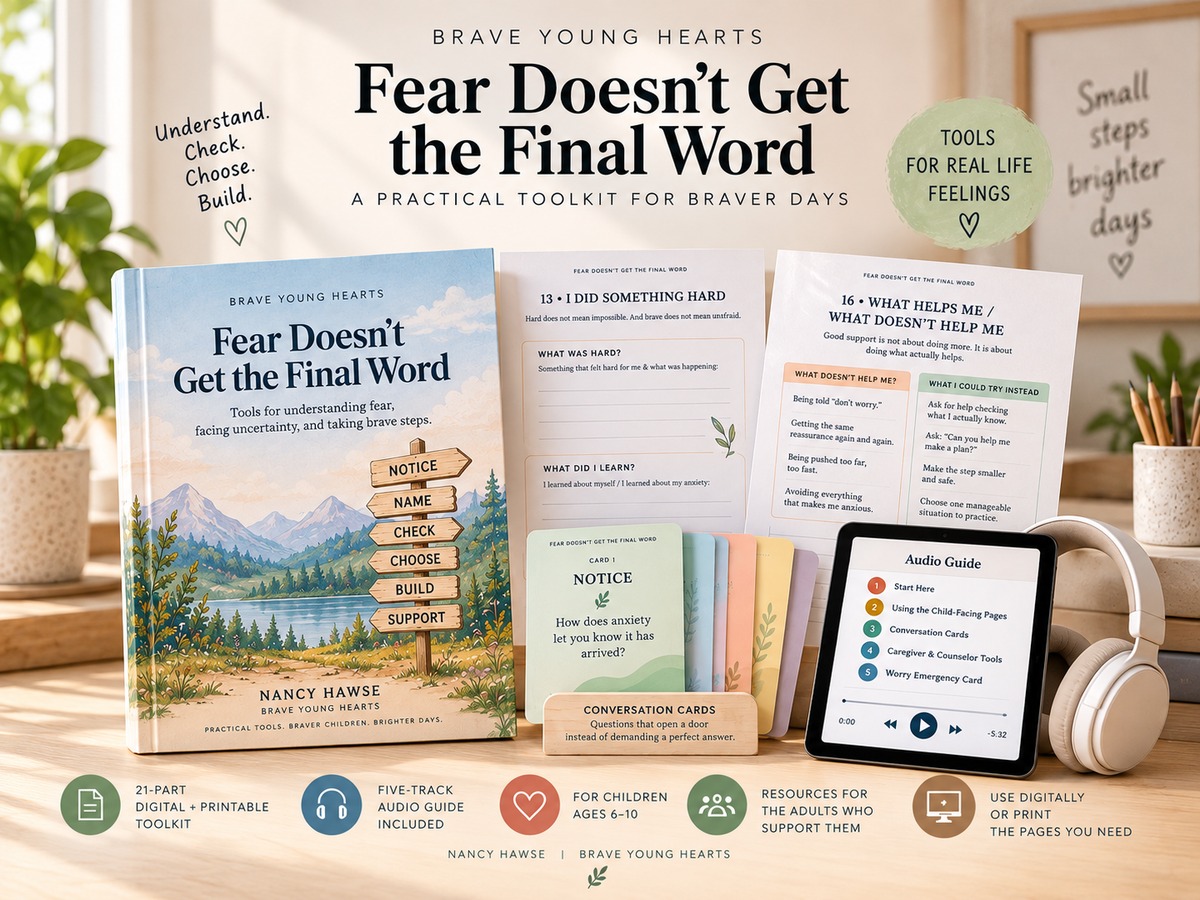
A look at the toolkit and the kinds of resources included.
Why this exists
When a child is caught in a worry loop, “You'll be fine” can feel reassuring for a moment.
But what happens when the next what if? arrives?
The worry comes back. The questions come back. And sometimes the child starts relying on someone else to make the uncertainty disappear.
Fear Doesn't Get the Final Word takes a different approach.
NOTICE
What is happening?
NAME
What am I feeling, thinking, or worrying about?
CHECK
What is real — and what is fear predicting?
CHOOSE
What is one safe, manageable next step?
BUILD
What evidence am I collecting about what I can handle?
SUPPORT
Who can help, and when should I ask?
Because the goal isn't a child who never feels afraid. It's a child who knows what to do when fear shows up.
What's actually inside
The child-facing activities and adult support tools come together in one system, so the adults around a child can use a shared language and approach.
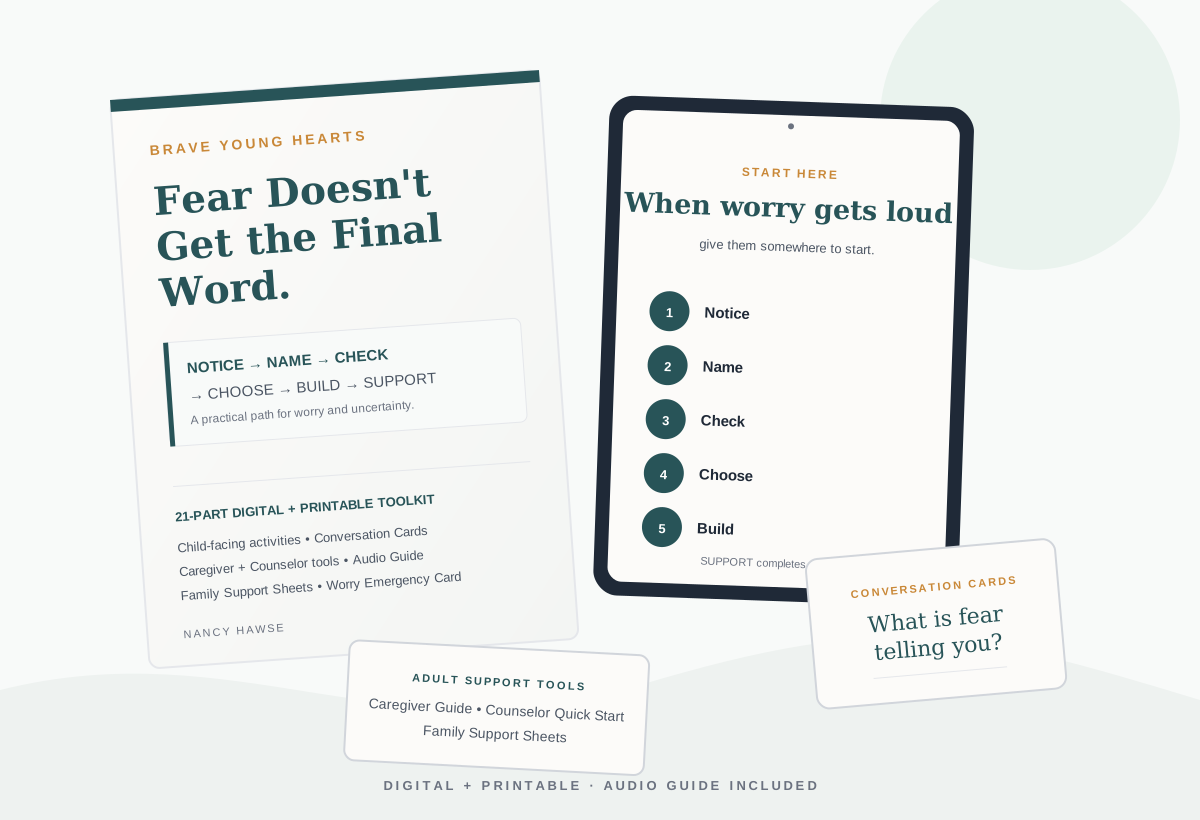
Built as one system
Everything is designed to work together.
You don't have to use every tool at once. Start with the moment you're in. Choose what fits. Come back when you need it.
Designed to be used
Print the pages. Use them digitally. Keep the Conversation Cards nearby. Listen to the Audio Guide when you'd rather be guided.
Included
Five short audio walkthroughs
Including a standalone track for the Worry Emergency Card.
Who it's for
“I know they're worried. I just don't know what to say next.”
For the moments when a child is caught in a what-if, avoids something because it feels scary, or keeps coming back for reassurance.
For children who need a little more language, structure, or support to work through a difficult moment.
A practical resource for conversations, practice, and building capability across the children you support.
A shared language for talking about worry, uncertainty, feelings, and what might help.
You don't need to be an expert. You don't need to know exactly what to say. You don't need to use every page at once.
You just need a place to start.
The philosophy
Fear has a purpose. And sometimes fear is telling us something important.
The goal isn't to teach a child to ignore fear, push it away, or pretend everything is fine. It's to help them learn the difference between feeling afraid and being in danger.
To notice what is happening. To check what is real. To recognize what fear is predicting. And, when the situation is safe, to choose one manageable step forward.
FEAR
Something might go wrong.
CHECK
What do I actually know?
CHOICE
What is one safe thing I can do?
EVIDENCE
What did I learn about what I can handle?
Fear can be part of the story. It doesn't have to write the ending.
The offer
One-time purchase
$49
No subscription. No free trial. No complicated setup.
Get Fear Doesn't Get the Final Word — $49Start with 00 · Start Here.
A few things you may be wondering
It is designed primarily for children ages 6–10, with resources for the adults who support them.
No. This is a digital + printable toolkit. You can use the resources digitally or print the pages you want to use.
The complete 21-part toolkit, including child-facing resources, Conversation Cards, Caregiver Guide, Counselor Quick Start Guide, Family Support Sheets, Worry Emergency Card, and Audio Guide.
Yes. Your purchase includes five short audio walkthroughs, including a standalone walkthrough for the Worry Emergency Card.
No. Start with 00 · Start Here to find the most relevant place to begin. You can use individual tools as needed and return to them later.
Yes. The toolkit is designed for use by parents and caregivers with the children they support, and by teachers, counselors, and other support professionals working with multiple children. You can print and reuse the applicable resources within your personal, classroom, counseling, or professional setting. The toolkit is licensed for individual/family and professional use; it is not intended for resale, redistribution, or sharing of the original digital files.
No. It is an educational and emotional-wellness resource. It does not replace professional diagnosis, treatment, or individualized clinical care.
Safety comes first. The toolkit should not be used to reinterpret genuine danger as anxiety. If there is an immediate safety, medical, safeguarding, or other serious concern, seek the appropriate emergency or professional support.
Start with 00 · Start Here. You can also listen to Audio Guide — Track 01: Start Here for a guided introduction.
Start here
You don't have to have the perfect words. You don't have to make fear disappear. And you don't have to use every page at once.
Start with one conversation. One question. One safe step.
Get the Toolkit — $49For children ages 6–10 · Parents & caregivers · Teachers · Counselors & support professionals
Created by Nancy Hawse
Children's Author · Social-Emotional Learning & Emotional Wellness